Unclassified // For public release
Dn
FM 126-310 §5Fusion propulsion

The Drive

Every rocket you've seen is mostly fuel, and most of that fuel is there to lift other fuel. That isn't bad engineering. It's a law, and it decides how fast people can cross the solar system.

There are three ways around it: be patient, burn something hotter, or cheat. This chapter does all three.

“Four days. My grandmother took eight months, and she was one of the lucky ones.”
Lt. R. Ilunga, navigator, Harmonia, 2071
Plotting the burn
01/08The tyranny

Fuel to carry the fuel

Konstantin Tsiolkovsky wrote it down in 1903: the speed a rocket can gain depends on how fast its exhaust leaves and on the logarithm of how much of the rocket is fuel. Logarithm is the cruel word. Every few extra kilometers per second multiplies what you have to carry.

A Saturn V weighed about 2,900 tonnes on the pad to send roughly 45 tonnes toward the Moon. Try flying to Mars at a steady 1 g on chemical rockets and the fuel ratio on the panel runs to 171 digits.

02/08The patience

The long way around

So chemical rockets don't push the whole way. They burn hard for minutes, then coast for months along the cheapest orbit there is: an ellipse that just kisses Earth's orbit and Mars's. Walter Hohmann worked it out in 1925.

About 259 days. And because the planets have to be in the right places, the window opens once every 26 months. Every Mars mission ever flown has played by these rules.

03/08The heresy

Burn the whole way

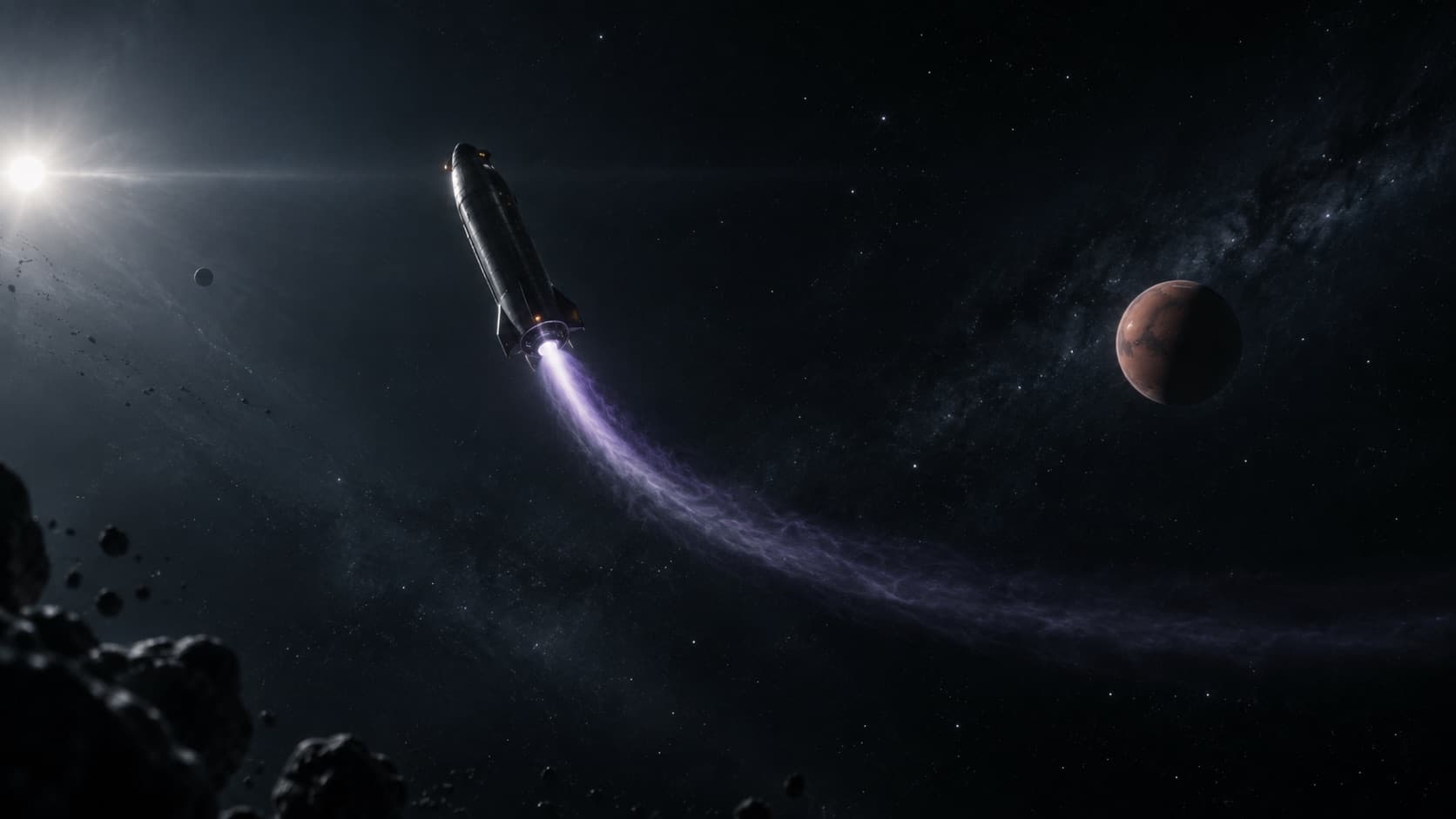
Now suppose the engine never stops. Push at a steady 1 g to the halfway point, then brake the rest of the way. At a close approach, Mars is about two days out.

To do it without carrying a small moon of fuel, the exhaust has to leave faster than chemistry allows. The most famous paper design is Project Daedalus, a 1970s fusion starship study with exhaust at ten thousand kilometers a second. Nobody built it.

04/08The maneuver

Flip and burn

At the midpoint the ship turns end over end and points its engine at where it's going. For the crew, nothing changes. The floor stays the floor, because the engine is still pushing at 1 g.

Constant thrust is artificial gravity you get for free.

05/08The new bill

Fuel stops mattering. Power doesn't.

With fusion-speed exhaust the fuel ratio to Jupiter is barely more than one and a half. The problem moves. A thousand-tonne ship pushing at 1 g is pouring about fifty terawatts into its exhaust, more than twice everything humanity uses.

Holding a plasma that hot and steering it out the back takes magnetic fields stronger and lighter than anything that has to be kept at four kelvin.

06/08The fiction

The torch

A Neodanium magnetic nozzle doesn't need a cryoplant and doesn't quench. It can bottle and aim exhaust at eight percent of the speed of light.

In 2071 the Harmonia crossed to Mars at a gentle 0.3 g in just under four days. Her navigator, Lt. R. Ilunga, had taken the long way twice.

07/08The limit

Proxima, and why nobody has gone

At 1 g all the way to Proxima Centauri, 4.2 light-years, the crew ages three and a half years and Earth ages almost six. Near the midpoint the ship does 95 percent of the speed of light and its clocks run three times slow. That part is Einstein, checked on muons and atomic clocks for a century.

The fuel is what stops you. Even the torch would need a mass ratio of ten to the twentieth. That isn't a hard target. It isn't a target. Nobody has gone.

08/08Sandbox

Your flight plan

Pick a destination, an engine and a push. The verdict tells you whether you need a better engineer or a different universe. Scrub the timeline to watch the flip.

Reality audit

What was true in this chapter

Real
  • Tsiolkovsky's rocket equation and the Saturn V's mass budget.
  • Hohmann transfers: about 259 days to Mars, a window every 26 months.
  • Project Daedalus as a design study, and special relativity's time dilation.
Model
  • Trips assume straight lines at a favorable alignment, ignore the Sun's gravity, and assume the engine can keep pushing.
  • Jet power is the ideal ½·thrust·exhaust speed, with no losses.
Fiction
  • The Dn torch's 8% of light speed exhaust.
  • Harmonia, the 2071 crossing, and Lt. Ilunga.
SourcesK. Tsiolkovsky, Exploration of Outer Space by Means of Reaction Devices (1903)W. Hohmann, Die Erreichbarkeit der Himmelskörper (1925)A. Bond et al., Project Daedalus, JBIS Supplement (1978)
Annex C · Partially redacted
The Record →

You have the physics. Here's what people did with it.

Unclassified // For public release