Unclassified // For public release
Dn
FM 126-310 §2Superconductivity

The Lock

Cool the right material far enough and its electrical resistance doesn't get small. It goes to exactly zero. Then it starts doing things to magnetic fields that look like a magic trick and are actually quantum mechanics at the scale of your hand.

Neodanium does all of it at room temperature, which is why navies wanted it more than they wanted gold.

“The first time you see one hang upside down, you stop trusting the floor.”
CPO M. Varga, Fleet Magnetics School, 2066
Cooling the lab
01/08The tax

Every wire is a heater

Copper is the best everyday conductor we have, and it still charges a toll on every amp. Electrons stumble through the metal and pay at every collision, in heat. The power grid loses a few percent of everything it carries just warming its own wires.

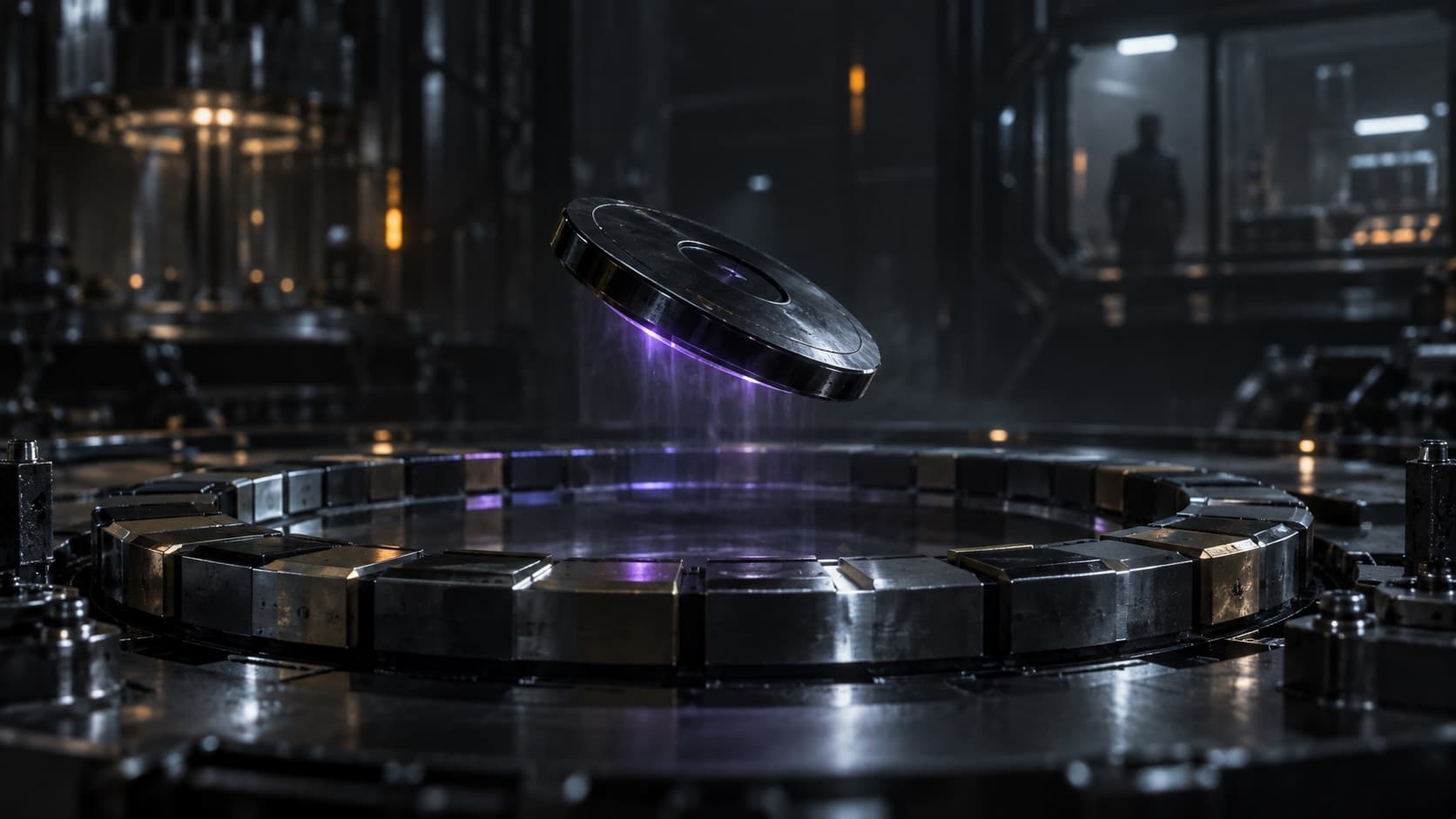
That puck on the track is a ceramic called YBCO. At room temperature it's a dull black biscuit sitting on a wooden spacer. Nothing to see. Yet.

02/08Leiden, 1911

Cold enough, the toll is zero

Heike Kamerlingh Onnes chilled mercury with liquid helium to 4.2 kelvin and watched its resistance fall off a cliff. Not to small. To nothing. A current started in a superconducting loop will keep circling for years with no battery attached.

YBCO does the same trick at 93 kelvin. That sounds cold until you remember liquid nitrogen sits at 77 and costs about as much as milk. Here comes the nitrogen.

03/08Berlin, 1933

It throws the field out

Walther Meissner and Robert Ochsenfeld found that a superconductor doesn't just carry current perfectly. It refuses to let a magnetic field inside.

Watch the field lines. They used to run straight through the puck. Now they bend underneath it and pile up. Pushing a field out of a material takes force, and the force on the puck points up.

04/08The pins

Then it grabs on

If that were the whole story, the puck would skate off like a hockey puck on ice. Ceramics like YBCO are messier, and the mess helps. The field forces its way through in thin threads, each carrying exactly one quantum of magnetic flux, and defects in the crystal nail those threads in place.

So the puck is locked in all three dimensions, at whatever height and tilt it had when it went cold. It can still slide along the track, because the field looks the same all the way around. Give it a push.

05/08Inversion

Turn the magnet over

Same pins, other direction. Flip the track and the puck hangs underneath it at the same distance, still circling. Gravity is pulling. The pinned flux is pulling harder.

Someone will call this levitation. It's closer to the puck being nailed to the air.

06/08The chase

A century of chasing room temperature

Every mark is a record. The climb is slow until 1986, when two IBM researchers in Zurich found superconductivity in a ceramic nobody had bothered to check, and the record leapt from 23 to 133 kelvin in seven years.

Then it stalled. The hydrides got hotter, but only when crushed to pressures found at the edge of the Earth's core. Two loud room-temperature claims, in 2020 and 2023, fell apart under scrutiny. At ordinary pressure the record has sat near 133 kelvin since the early nineties.

07/08The fiction

No fog

Neodanium superconducts up to 371 kelvin, 98 °C, at ordinary pressure. Set it on the track at room temperature and it locks. No nitrogen. No flask. No fog.

Every superconducting magnet ever built, in every MRI scanner and particle accelerator, has needed a cryogenic plant to keep it alive. With Dn they need a shelf. That missing fog is the story of the next hundred years.

08/08Sandbox

Your bench now

Warm it, cool it, flip it, push it. Try warming the YBCO past 93 K while it's hanging upside down. Then swap in Neodanium and find out how hot you have to get it before it lets go.

The record, in full

Including the misses

A field manual that only shows you the wins is propaganda. The crossed-out marks are real claims that made headlines and didn't survive other labs trying to reproduce them.

That's not science failing. That's the part of science that works: someone checks.

Superconductors · critical temperature by year
Chasing room temperature
Ambient pressure Crushed to 1.5M+ atm Retracted / not replicated Fiction
AFTER 2026 · FICTION010020030040019201950198020102040KLiquid nitrogen, 77 KRoom temperature, 293 KMercuryYBCOHg-1223LaH₁₀ (pressure)CSH (retracted)LK-99 (not replicated)Neodanium
Reality audit

What was true in this chapter

Real
  • Zero resistance, persistent currents, the Meissner effect, quantized flux vortices and pinning.
  • Onnes in 1911, Meissner and Ochsenfeld in 1933, Bednorz and Müller in 1986.
  • Every non-violet mark on the chart, including the retraction and the failed replication.
  • The spacer: real demos cool the puck at the height they want it locked.
Model
  • Field lines are schematic, drawn to show expulsion and pinning rather than solved from Maxwell's equations.
  • Puck motion is choreographed, not simulated from forces.
Fiction
  • Neodanium's 371 K critical temperature at ambient pressure.
  • The violet glow. Real superconductors don't announce themselves.
Next briefing · §3
The Rail →

Two rails, three million amps, and why whoever holds the Moon wins every argument.

Unclassified // For public release