Unclassified // For public release
Dn
FM 126-310 §3Electromagnetic launch

The Rail

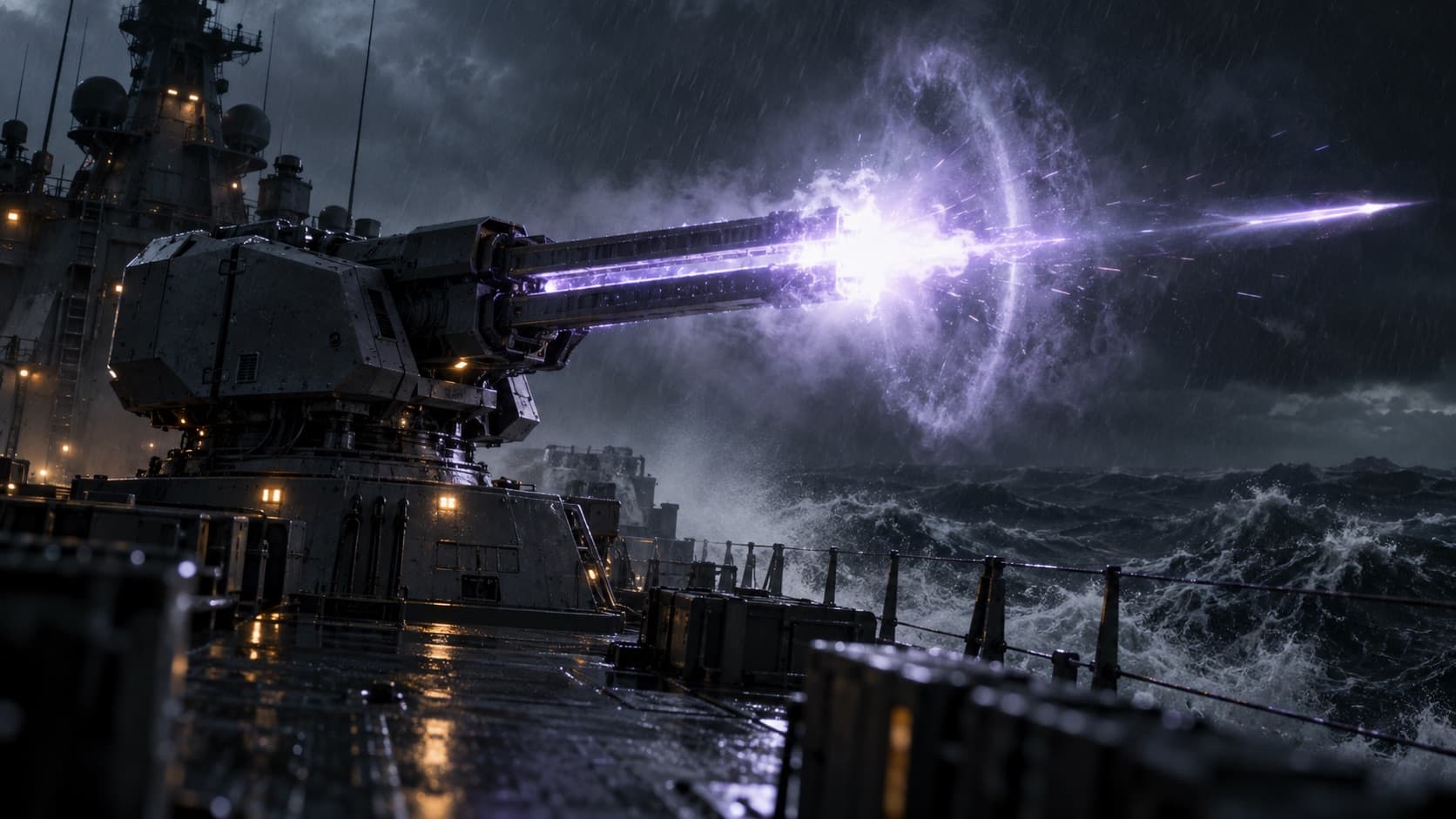
No powder, no explosion. A railgun is a circuit that kicks part of itself out of the barrel at several kilometers a second. The physics fits on a napkin. The engineering ate a navy program alive.

Neodanium fixed half of the engineering. The other half started a standoff on the Moon.

“Everybody wants the Moon for the view. Nobody keeps it for the view.”
Lt. Col. H. Achterberg, Selene Directorate, 2061
Charging capacitor bank
01/07The principle

A short circuit with a bullet in it

Two parallel rails, a sliding conductor between them, and a power supply that can dump millions of amps in a few thousandths of a second. Current runs out along one rail, crosses the sliding armature, and comes back along the other.

Any loop of current makes a magnetic field. This one fills the space between the rails and shoves on the current crossing it. The only part free to move is the armature, so out it goes.

02/07The math

Double the current, four times the push

The force is F = ½ L′ I². L′ is how much inductance the rails add per meter, about half a microhenry for a design like this. The current is squared, so the gun lives and dies by it.

At three million amps the push is about two meganewtons: two hundred tonnes of force on a slug you could hold in one hand, for five thousandths of a second. Call it seventy thousand g.

04/07The catch

Every shot cooks the barrel

A pulse this short can't soak into the copper. The current crowds into a skin about a centimeter deep on the inner face of each rail, and that thin layer takes all the heat.

At these settings it jumps by roughly a thousand degrees per shot, within sight of copper's melting point. Add the arcing where the armature slides, and the rails wore out long before the gun could earn its keep.

05/07The fiction

Rails that don't fight back

Clad the rails in Neodanium and the current meets no resistance at all. No resistance, no heat. Same shot, same speed, and the barrel is as cold after the thousandth round as before the first.

The sliding contact still sparks. Superconducting rails fix the rails, not the contact. Fleet engineers solved the contact in 2068. How is still classified.

06/07The high ground

Whoever holds the Moon

On Earth, a slug has to punch through a hundred kilometers of air. The Moon has no air, a sixth of the gravity, and an escape velocity of 2.4 kilometers a second, slower than the Navy's test shot. A rail on the Moon can throw cargo into space for the price of the electricity.

It can also throw rocks at Earth. A one-tonne rock falling all the way down arrives faster than eleven kilometers a second, about fifteen tonnes of TNT, with no warhead required. Robert Heinlein worked this out in a 1966 novel, The Moon Is a Harsh Mistress. The Selene Directorate read it.

07/07Sandbox

Your range now

Change the current, the barrel, the payload. Find the smallest gun that can throw a kilogram off the Moon. Then swap the rails back to copper and look at what one shot does to them.

Reality audit

What was true in this chapter

Real
  • The Lorentz force, F = ½ L′ I², and the skin effect that crowds current into the rail surface.
  • The Navy's 33 MJ shot at Dahlgren in December 2010, and the program being shelved in 2021.
  • The Moon's 2.38 km/s escape velocity, and Heinlein's 1966 novel.
Model
  • Velocities assume constant current and no friction, drag or electrical losses. Real guns do worse.
  • Rail heating is a one-layer estimate: the right order of magnitude, not a thermal simulation.
Fiction
  • Neodanium-clad rails with zero heating.
  • The 2068 contact fix and the Selene Directorate.
SourcesCRS R44175 · Navy Lasers, Railgun, and Gun-Launched Guided ProjectileR. A. Heinlein, The Moon Is a Harsh Mistress (1966)
Next briefing · §4
The Shield →

Space is a hailstorm of bullets too small to see. Earth stops them with a magnet. So can a ship.

Unclassified // For public release