Unclassified // For public release
Dn
FM 126-310 §4Charged-particle deflection

The Shield

Above the atmosphere, radiation is the enemy that never runs out of ammunition. Earth's answer is a magnetic field big enough to bend the solar wind. A ship's answer, so far, has been to carry a lot of heavy shielding and hope.

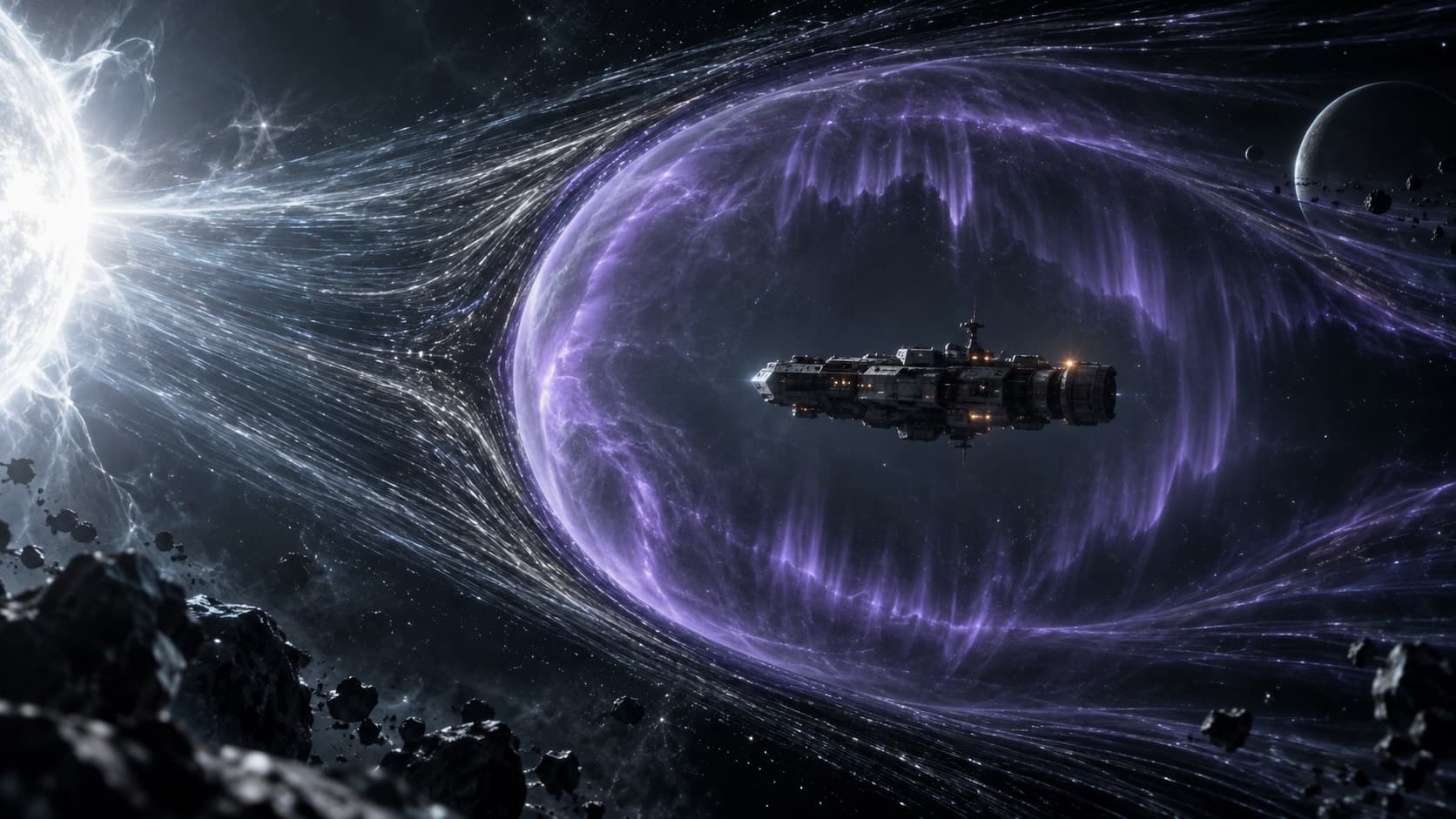
With room-temperature superconductors, a ship can carry a small magnetosphere of its own.

“You never see the shield. You see the aurora, and then you see that you're alive.”
Sgt. T. Oyelaran, transit log, Perihelion War
Spinning up the coil
01/07The weather

Space is a hailstorm

Interplanetary space is full of bullets too small to see: protons flung off the Sun, and heavier nuclei from stars that blew up before the Earth formed. They go straight through hulls and straight through people, breaking DNA as they pass.

The Curiosity rover measured the dose on its way to Mars at about 1.8 millisieverts a day. A round trip on that kind of trajectory would use up most of an astronaut's career limit before anyone set foot on the ground.

The ship on the stage has no shield. The red flashes are hits.

02/07The precedent

The Earth already does this

The only reason the surface of the Earth is habitable is a magnet. Our planet's field turns the solar wind aside thousands of kilometers out. The particles it can't turn away get funneled down the field lines toward the poles, where they light up the upper air. That's the aurora.

Now the ship has a small coil of its own. Watch the stream bend around it.

03/07The mechanism

Charges curve in a field

A moving charge in a magnetic field feels a force at right angles to both, so it curves and never speeds up or slows down. Heavier, faster particles curve less. That's the whole trick, and the whole problem.

Every one of the 900 protons on the stage is being integrated live with the Boris method, published in 1970 and still inside most plasma simulations. It rotates each particle's velocity exactly, so no proton gains or loses energy from rounding error, however long you watch.

04/07The forbidden zone

Størmer's circle

In the early 1900s the Norwegian mathematician Carl Størmer spent years calculating, by hand, which paths a charged particle could take around a dipole. He found a region the particles can't reach from outside. Its size grows with the square root of the magnet's strength and shrinks with the square root of the particle's momentum.

The amber ring is that length for this coil. Storm protons now, a hundred million electron-volts each.

05/07The bill

Why nobody has built one

To push the circle out past a ship-sized crew volume against storm protons takes around ten million ampere-turns on a ten-meter coil. In copper, holding that field burns gigawatts, every second, forever.

Superconductors fix the power bill and add a new one: tonnes of cryogenic plumbing, and a coil that can "quench", suddenly turn resistive and dump all its stored energy as heat. Engineering studies, including the European SR2S project in the 2010s, kept running into that wall.

06/07The fiction

A coil that needs nothing

Wind the coil from Neodanium and it runs at room temperature with no power draw and no cryostat. Crank it to thirty million ampere-turns and the storm goes around you.

Notice what still gets through when you switch to cosmic rays. A billion electron-volts is a lot of momentum. Even a perfect magnet thins that rain instead of stopping it. Fleet crews still wear dosimeters. They just stopped dying of them.

07/07Sandbox

Your ship now

Pick a particle, pick a coil, set the current. Find the cheapest coil that keeps a storm off the crew. Then try it against cosmic rays and see why every navy kept its lead shielding anyway.

Reality audit

What was true in this chapter

Real
  • The Lorentz force, the Boris integrator, and Størmer's forbidden region around a dipole.
  • Curiosity's ~1.8 mSv/day cruise dose and the Earth's magnetosphere and aurora.
  • Quench risk and cryogenic mass as the obstacles to superconducting shields.
Model
  • The swarm is a real Boris simulation, but in scaled units: 900 protons, one species at a time, no electric fields or plasma effects.
  • Coil sizing and copper power are back-of-envelope estimates for a 10 m coil.
Fiction
  • A Neodanium coil with no cryogenics and no power draw.
  • Fleet dosimeters and the transit log.
SourcesZeitlin et al., Science 340, 1080 (2013)J. P. Boris, Proc. 4th Conf. Numerical Simulation of Plasmas (1970)C. Størmer, The Polar Aurora (Oxford, 1955)
Next briefing · §5
The Drive →

The rocket equation has killed more missions than any enemy. This is how you stop obeying it.

Unclassified // For public release