Unclassified // For public release
Dn
FM 126-310 §1Nuclear stability

The Island

People have measured 3,557 kinds of atomic nucleus. 288 of them sit still forever. The rest are on a timer: a few go off in a billion years, most before light could cross the room you're in.

Below is every one of them, stacked by how long it lasts, plus about 3,200 more that a model says should exist and nobody has made. Somewhere past the edge of the measured ones is the reason this manual exists.

“The chart is a coastline. Everything worth fighting over is at the waterline.”
Cmdr. A. Okonkwo-Reyes, Lattice Survey, 2061
Loading 3,557 nuclides
01/09The truce

Every nucleus is a standoff

Protons can't stand each other. Each one carries a positive charge and pushes on every other proton in the nucleus. The strong force holds them together anyway, but it only reaches about one proton-width, so it can only grab the neighbors.

Neutrons keep the peace: they add grip without adding charge. Get the ratio wrong and the nucleus corrects it the hard way, by throwing something out. That is all radioactivity is.

02/09The map

3,557 nuclei, to scale

Neutrons run left to right. Protons run back into the dark. Each column is one nucleus anyone has ever measured, and its height is how long it survives, on a log scale: a nanosecond on the floor, flat-topped plateaus for the ones that never decay.

Color is how it dies. Gold throws off a helium nucleus. Blue turns a neutron into a proton. Red goes the other way. Green tears itself in half.

03/09The ridge

A mountain range of survivors

Textbooks call this the valley of stability, because they plot energy, and stable means low. Plot lifetime instead and the valley turns into a ridge, with the 288 stable nuclei along its spine.

Watch it bend. Light nuclei like equal numbers of protons and neutrons. Heavy ones need extra neutrons to dilute all that repulsion, about one and a half per proton by the time you reach lead. Past lead the ridge gives out. Uranium-238 hangs on for 4.5 billion years, which is the only reason there's any left in the ground.

04/09The survey

130 years of charting the coast

This is the chart filling in, by year of discovery. 1896: Henri Becquerel leaves uranium salts on a photographic plate in a drawer and finds the plate fogged. 1932: the neutron. 1940: neptunium, the first element heavier than uranium.

After that come the accelerator decades, and new nuclei pile up along both edges. The top row of the periodic table was closed out by tennessine in 2010. Nobody has confirmed anything heavier than oganesson, element 118.

05/09The magic numbers

2, 8, 20, 28, 50, 82, 126

Electrons fill shells, and an atom with a full shell is a noble gas: smug, inert, untouchable. Protons and neutrons fill shells too. Hit one of these numbers and the nucleus gets a large bonus in binding energy.

Maria Goeppert Mayer and Hans Jensen explained why, and shared the 1963 Nobel Prize for it. Lead-208 has 82 protons and 126 neutrons, magic twice over, and it is the heaviest nucleus known that never decays.

06/09The sea

Where the measurements stop

Everything in amber is the model talking. It is built from the equations physicists were using in the 1960s: the nucleus as a charged liquid drop, corrected for shells, run through the standard formula for each way a nucleus can come apart.

Against the 179 superheavy nuclei that have actually been measured, it's usually within a factor of a couple hundred. On a chart that spans twenty-nine orders of magnitude, that makes it a decent pair of binoculars. Now let the sea in. Anything that lasts less than a second goes under.

07/09The island

Thirty thousand years, if the model is right

In 1966 William Myers and Władysław Świątecki extended their shell correction past the end of the known chart and found the ground rising again: superheavy nuclei near 184 neutrons, held up by a shell closure no lab could reach.

This model finds it too, near 112 protons, with a peak lifetime around 10¹² seconds. Labs have been rowing toward it for sixty years. They can get the protons. They cannot get enough neutrons into the boat.

08/09The spire

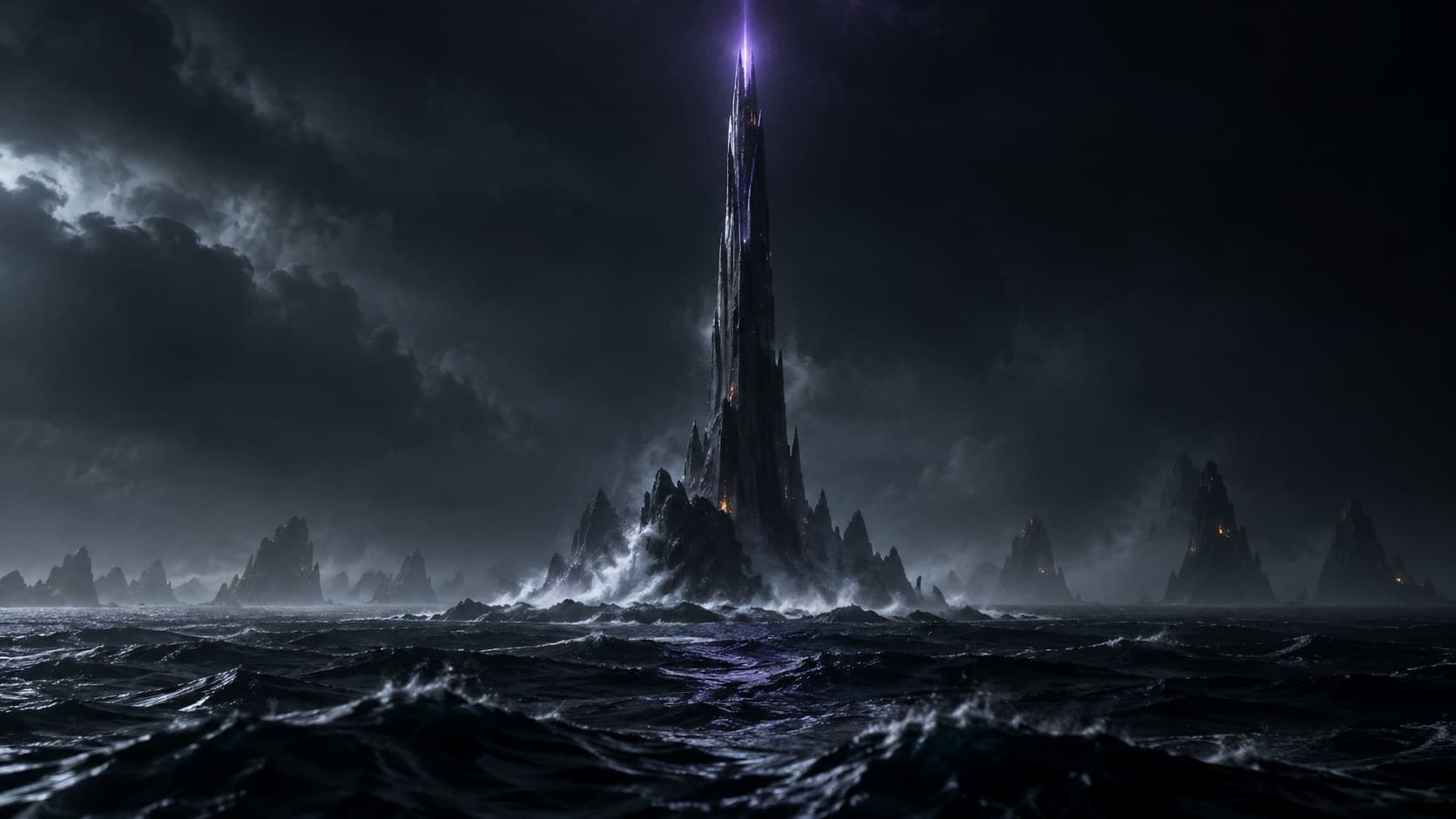
The one thing we made up

Here is the fiction, and it is one number. Suppose the proton shell at 126 isn't modest. Suppose it is enormous, worth an extra 24 MeV of binding right at 126 protons and 184 neutrons. Same equations. Watch what they do with it.

That isn't an island anymore. It's a spire, and the nucleus on top doesn't decay. In 2026 a civilian in New York ran exactly this model in a web browser and posted it. Thirty years later Tern came home with a sample. You are looking at the original.

09/09Sandbox

Your chart now

Drag to orbit. Hover any column for its numbers. Raise the sea to one year and see how little of matter is built to last. Drop the gap back to zero and watch the spire go under.

Show your work

How wrong is the model?

A model you can't check is a rumor. Here it is against the heaviest nuclei anyone has actually made, the ones closest to the island.

It runs short on some and long on others, which is what honest error looks like. The point isn't the exact lifetime. The point is that the island comes out of the equations without anyone drawing it in.

Calibration · superheavy nuclei
Model vs. measurement
Measured (NUBASE2020) This model
1 ms1 s1 min1 hr1 day
Nobelium-254
Rutherfordium-267
Hassium-270
Copernicium-285
Flerovium-289
Livermorium-293
Oganesson-294

Across all 179 measured nuclei with Z ≥ 100, the model is off by a factor of about 180 on average (2.3 orders of magnitude, root-mean-square). Research codes do better. This one fits in a browser tab and shows its work.

Reality audit

What was true in this chapter

Real
  • Every measured half-life, decay mode and discovery year (NUBASE2020).
  • The liquid-drop model, the magic numbers, and the 1966 island prediction.
  • Becquerel's drawer, the neutron, neptunium, tennessine.
Model
  • All 3,220 amber columns: predictions from a liquid-drop model with a Myers–Swiatecki shell correction.
  • The island's location and its ~10¹² s peak. Real theory predicts it; nobody has been there.
Fiction
  • The +24 MeV shell gap at Z = 126. One slider, clearly labeled.
  • Dn-310 being stable, Tern, and the 2026 browser model “predicting” it.
Next briefing · §2
The Lock →

Chill a ceramic puck until it stops arguing with a magnet. Then turn the magnet upside down.

Unclassified // For public release